

How relentless simplicity scaled a $500m business
Sean Griffey on building repeatable models, staying profitable, and scaling without complexity

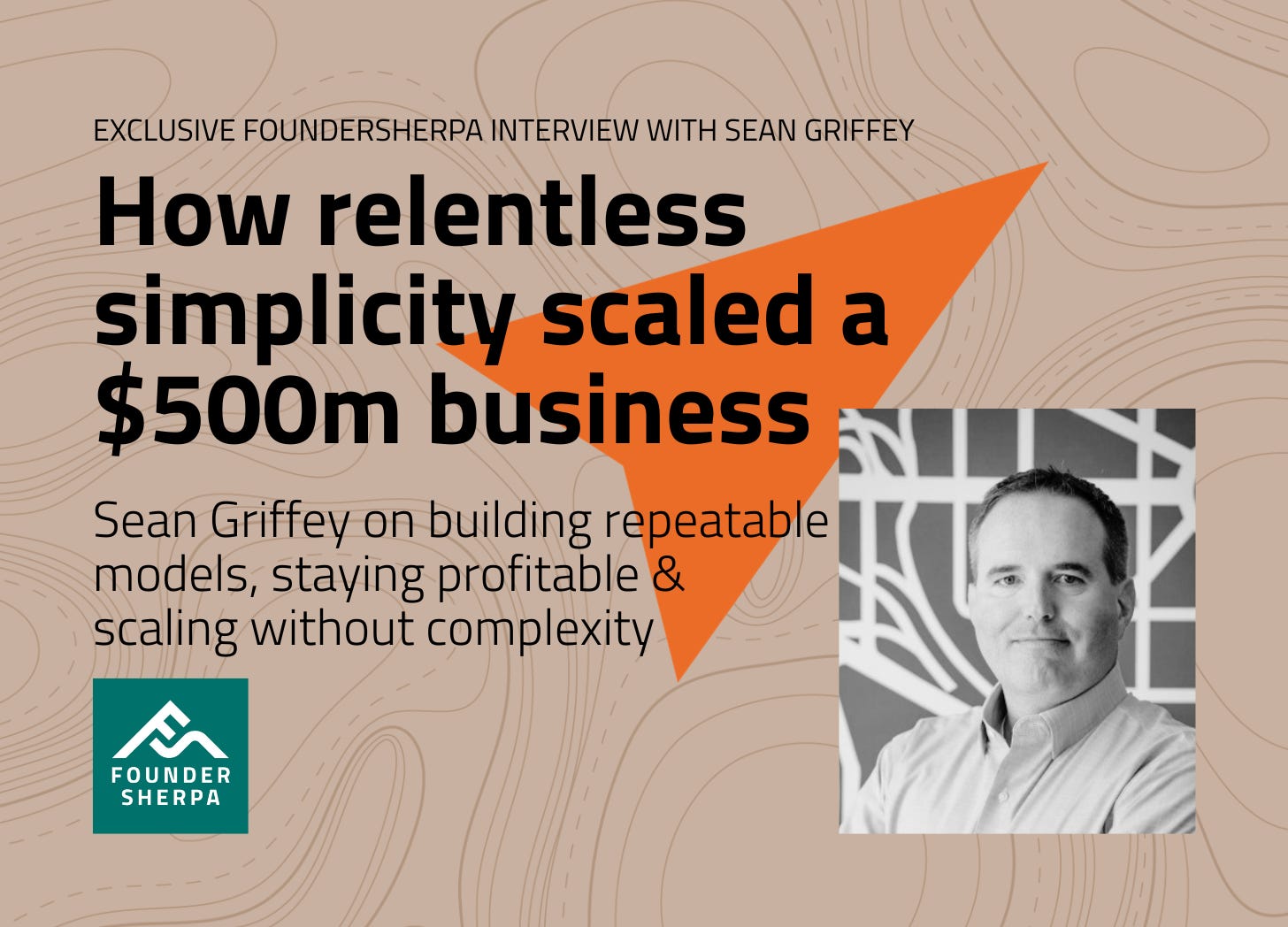
Sean Griffey doesn’t tell his story like someone who built a $500m company.
“I don’t think I ever expected the business to become what it became,” Sean says.
Back in 2012, he and his two co-founders launched Industry Dive with modest ambitions and just $400,000 in angel funding. As he says, “we basically bootstrapped from there”. They chose not to raise venture capital.
Industry Dive became profitable in 2013, its second year of operation, and remained so throughout its growth.
A decade later, Industry Dive was generating approximately $110m in annual revenue, with profit margins of around 30%. It was serving nearly 13 million executives across more than 20 specialist industries through 27 digital publications and over 70 newsletters. In 2022, it was acquired by Informa for an enterprise value of $525m, representing nearly five times annual revenue.
Looking back, Sean sees two distinct exits in that journey, not one. And neither was as simple as it looked from the outside.
The first came in 2019, when, after seven years of bootstrapped growth, the founders sold a majority stake to private equity firm Falfurrias Capital Partners. At the time, Industry Dive was generating just under $30m in revenue.
The second came three years later, with the sale to Informa.
The unspoken advantage - people
Sean had one significant advantage that he was keen to highlight – he wasn’t scaling alone.
“I was never one of those founders who was making decisions alone,” he says. “I always had two co-founders who were incredible thought partners.”
The three had worked together for more than 20 years, and as they embarked on Industry Dive, their roles were clear from the outset. They knew they shared complementary skills and were prepared for inevitable disagreements, but never had any doubt about their intentions for the business. That alignment created stability.
He was also keen to make clear that his story is not one he would have written for himself, but rather a series of what he sees as lucky circumstances that supported him as he built, scaled and sold (twice).
Sean believes that there’s a lot to be said for surrounding yourself with people who have different expectations of what’s possible in life.
“I got lucky with business school changing my mind, lucky to be early at Fierce Markets where I met my co-founders, and lucky to have a family that could help make it happen. You have to line all that up. I could live 100 lives and not end up here.”
Building the business: simplicity as strategy
Industry Dive’s model was deceptively simple: build highly focused digital publications serving specific B2B sectors such as retail, healthcare, energy, food and supply chain, and deliver curated daily insights to decision-makers.
The business expanded to cover more than 20 industries with 27 publications. But inside the company, the operating principle was almost obsessive. Simplicity.
Sean and the team constantly asked themselves:
“How do we make the product, messaging and processes that underpin them simpler?”
Sean believes that complexity kills growth and compounds mistakes. Because they were replicating the same model across more than 20 industries, simplicity was not aesthetic. It was economic. If something works once, it can work repeatedly. Bootstrapping reinforced that discipline.
Other than the $400k raised from angel investors at the outset Industry Dive funded growth organically. In the early days, the founders chose not to pay themselves for an extended period. Venture capital offers came along, but the founders resisted.
“We didn’t want to build a business that required outside capital to survive,” he says. “We wanted control over our destiny.”
That choice shaped everything that followed.
The first exit: partnering with private equity
In 2019, the founders sold a majority stake to Falfurrias Capital Partners, a Charlotte-based private equity firm that had raised approximately $1.9bn across its funds.
By that point, Industry Dive had been profitable for six consecutive years and had grown to just under $30m in revenue.
“They were an incredible partner that allowed us to accelerate. But before they arrived on the scene, I’d started getting the books in order, having third-party audits, thinking about how to raise money and then private equity came in and spoke about a vision of the future that was incredibly aligned with our views at the time. We were surprised - we considered ourselves contrarians!”
With Falfurrias’ backing, the company accelerated its expansion strategy, completing a series of acquisitions including NewsCred’s content marketing team and services, CFO.com, Mobile Payments Today, PharmaVOICE and Ladders News.
Over the following three years, revenue grew from just under $30m to approximately $100m, while the company continued to operate with strong margins. It all worked out as it’s supposed to with private equity – they buy a majority share and help you accelerate, grow and then sell again.
“What we made on the second bite of the apple was more significant than the first. Both numbers were life-changing for me.”
The Informa sale in 2022 marked the culmination of that second growth phase.
Staying on after the sale
Sean always knew that private equity ownership would likely lead to another sale in time. But when Industry Dive sold to Informa, he remained as CEO.
The sale came at a moment when the business had real momentum.
“We’d taken the business from $30m to $100m, and most of that was organic. But now it felt like a rocket ship.”
The timing mattered. Several market trends had lined up in the company’s favour, inbound interest was strong, and the founders and their private equity partners recognised that there was unlikely to be a better moment.
But selling the business did not mean Sean immediately let go of operating responsibility. He stayed on for two years after the acquisition, in part because there were structures tying him in, but also because he wanted to make sure the business landed well in its new home.
The real transition came later. Informa’s combination with TechTarget changed the shape of the job and the scale of the commitment ahead.
“That deal made a ton of sense, and I was strongly in favour. But it also meant massive upheaval. I looked at the work and time it would take, and knew if I stayed, I’d need to commit another three years to do it well.”
At that point, Sean made a pragmatic decision. He did not want to hold onto a big role and do it half-heartedly.
So, he left not at the point of sale, but two years later, when it became clear that the next chapter would demand more than he wanted to give.
The second exit: selling to Informa
The sale to Informa was significant financially. The $525m enterprise value included a cash value of approximately $389m, with additional potential earn-outs and rollover equity.
At the time of sale, Industry Dive employed roughly 380 people, including approximately 115 in editorial roles. All employees remained as part of the transaction, and the company continued to operate as a standalone brand within Informa.
Sean describes the process with cool detachment rather than triumph.
One of the deal’s defining features was cultural fit.
“We wanted a buyer who would invest in the business and in its people,” Sean says.
The goal was not simply to maximise price. It was to ensure continuity and growth. Because selling a business you have spent a decade building is not purely financial. It carries identity, relationships and memory.
“You’ve poured years of your life into this thing,” he says. “You can’t just switch that off. There’s always more to do”.
Even so, Sean looks back now and recognises it was “a pretty good run” but that the business landed in a good home.
Life after exit
After his exit, Sean agreed to stay on the board but also had a couple of other board roles lined up. He quickly came to recognise that board roles take some time, but not much time.
“Some want you to be really involved, and some want you to just come in from time to time and bless the deck.”
He promised himself that he would take six months and say no to everything, but recognises now that he was “only moderately successful at that” and signed up for more than he wanted or should have.
Underneath it all, he now realises that there was a more pressing concern:
“Candidly, there was this fear that it doesn’t take long to feel irrelevant. How do you stay plugged in, in case you want to do something ambitious again?”
Sean was very forthright about his reality today and realises that he’s still trying to piece it together. He recognises that he needs to say “no” a little more.
When he left Industry Dive, he was tired and really needed to recharge. He felt like he would know what he wanted to do next after 12 months or so, but he doesn’t feel like he’s there yet.
He was very clear that he’s not itching to get back into the game full-time, but still has that draw to be involved.
He has remained active as an investor and advisor, but with more choice over how he spends his time.
Sean’s biggest splurge was buying and renovating a new house by a lake, where he and the family can spend more time together, and taking better holidays. He knew he wasn’t a Ferrari guy.
And so that transition has been more of a gentle redesign of his life than a step towards retirement.
Lessons for scaling founders
Sean has one key message he was keen to share with scaling founders.
He explains, “If you’re still building the business, this is a great time to build relationships with people who’ll help you when the time comes to exit – that could be investment bankers or people in and around your industry.”
We went into this a little deeper. Sean was talking about connections with people who’ll understand how your business is perceived, what it’s worth, and what people say about it.
This is the time to look at your business from the perspective of a potential acquirer. Spend time with the banker. Know what a fair evaluation of your business is in the market. You can disagree. But know what the market sees.
Looking back, Sean identifies a few principles that mattered most.
1. Choose your partners carefully.
Two decades of working together before launching Industry Dive created trust that carried them through complexity and growth.2. Keep it simple.
Simplicity was not just lip service. It was operational discipline.3. Build something that works without you.
The business continued to thrive through changes in ownership and leadership, which reflected the strength of the systems and team built over time.4. Think about the kind of buyer you want.
The right exit is not just about valuation. It is about stewardship.
It was a pleasure to spend time with Sean – from bootstrapping, with minimal investment, it was a rollercoaster story about building deliberately, remaining profitable, scaling with institutional capital, and knowing when to let go.
And that may be the hardest achievement.
As always, thanks for reading. Please do subscribe if you haven’t already.
More soon,
Robin
Fantastic article and an important story in contrast to those who believe you must raise a ton of outside money. I feel privileged to have met Sean and the leadership team and their culture impressed me early on. In fact, I mentioned the company and what I saw as its strong leadership and culture to my sons who are now both employed there! Somehow ID managed to scale the culture to the point where that culture survived big changes at the top.
Really enjoyed reading this. As someone building a similar type of company, I learned so much from it, especially the point about simplicity.